Agentic Commerce
adidas International B.V.

Partner Fulfilment
As part of adidas' long-term Checkout 2027 vision, Partner Fulfilment explored how external inventory could become a native extension of the adidas shopping experience. Rather than treating partner fulfilment as a logistics capability, the work reframed it as a customer experience challenge:
How might adidas recover high-intent purchase demand without exposing consumers to inventory complexity?
The outcome of this phase was not a production-ready solution, but a strategic North Star; one that, in hindsight, mapped closely onto the architecture the industry is now converging on through open standards like the Universal Commerce Protocol (UCP). The core thesis was consistent with where agentic commerce has since landed: partner inventory should feel invisible, trusted, and fully integrated within the adidas ecosystem, with adidas remaining the single merchant of record regardless of who fulfils the order.
How might adidas recover high-intent purchase demand without exposing consumers to inventory complexity?
The outcome of this phase was not a production-ready solution, but a strategic North Star; one that, in hindsight, mapped closely onto the architecture the industry is now converging on through open standards like the Universal Commerce Protocol (UCP). The core thesis was consistent with where agentic commerce has since landed: partner inventory should feel invisible, trusted, and fully integrated within the adidas ecosystem, with adidas remaining the single merchant of record regardless of who fulfils the order.
Recovering demand without exposing operational complexity, and anticipating the infrastructure the industry is now standardizing around.
THE CHALLANGE
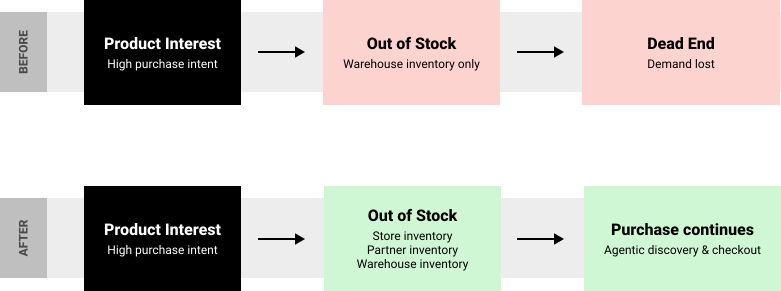
Inventory limitations create lost demand. When products become unavailable within adidas warehouses, consumers often reach a dead end despite continued purchase intent. The opportunity was never simply enabling external inventory.
The real challenge was preserving momentum. How can consumers continue purchasing without needing to understand where inventory comes from? And, increasingly, without needing to understand which surface they're purchasing on, as more of that journey shifts from adidas.com to AI agents acting on the consumer's behalf?
STRATEGIC CONTEXT
This initiative directly supported several strategic priorities:
The ambition was to evolve checkout from a transactional process into an intelligent fulfilment network capable of dynamically orchestrating inventory across adidas and trusted partners.
Viewed against adidas' current thinking on agentic commerce — where consumer journeys are understood to move across three coexisting AI waves (brand-led search, AI-assisted "buy with me," and AI-embedded "buy through me" checkout) — this initiative is in between Wave 2 and Wave 3: the point where AI begins doing the heavy lifting of where a product actually comes from, while the consumer simply validates a single, trusted purchase decision. The North Star effectively asked adidas to design for a "buy through me" reality before that reality had a name.
Inventory limitations create lost demand. When products become unavailable within adidas warehouses, consumers often reach a dead end despite continued purchase intent. The opportunity was never simply enabling external inventory.
The real challenge was preserving momentum. How can consumers continue purchasing without needing to understand where inventory comes from? And, increasingly, without needing to understand which surface they're purchasing on, as more of that journey shifts from adidas.com to AI agents acting on the consumer's behalf?
STRATEGIC CONTEXT
This initiative directly supported several strategic priorities:
- Checkout 2026: From Friction to Flow
- Connected Warehouse & Social Commerce
- Global Partner Fulfilment capability
- Unified Commerce Platform
- AI-supported commerce ecosystem
The ambition was to evolve checkout from a transactional process into an intelligent fulfilment network capable of dynamically orchestrating inventory across adidas and trusted partners.
Viewed against adidas' current thinking on agentic commerce — where consumer journeys are understood to move across three coexisting AI waves (brand-led search, AI-assisted "buy with me," and AI-embedded "buy through me" checkout) — this initiative is in between Wave 2 and Wave 3: the point where AI begins doing the heavy lifting of where a product actually comes from, while the consumer simply validates a single, trusted purchase decision. The North Star effectively asked adidas to design for a "buy through me" reality before that reality had a name.
MY ROLE
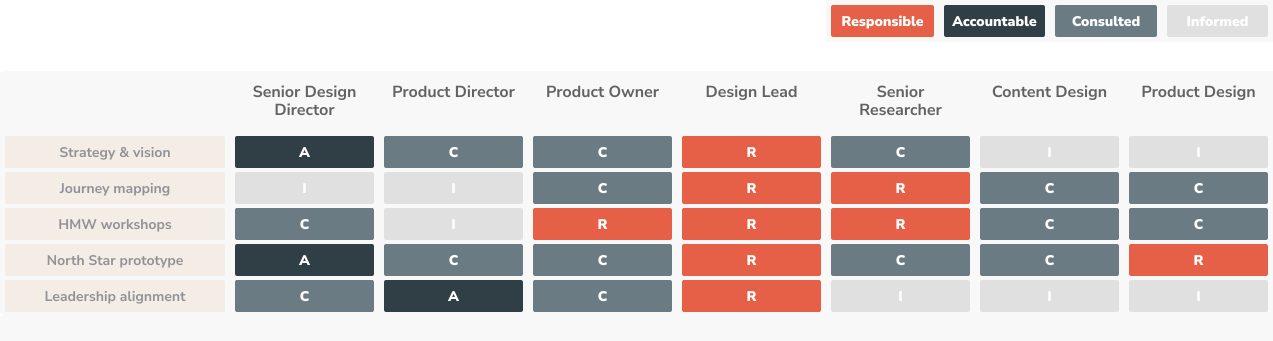
Responsible for defining the strategic experience vision, facilitating alignment across design, product and research, and shaping the North Star direction.
Deliverables included:
Responsible for defining the strategic experience vision, facilitating alignment across design, product and research, and shaping the North Star direction.
Deliverables included:
- Design Strategy Canvas
- Journey Mapping
- HMW Lists
- Opportunity Mapping
- Design Principles
- Strategic Decision Framework
- North Star Prototype
Honestly, it wouldn’t really matter who provided it. They were just the partner involved in the delivery process.
DISCOVERY
Research consistently showed one underlying pattern:
Consumers are not interested in inventory systems. They simply want the product they chose. Out-of-stock moments interrupt purchase momentum because they expose internal operational constraints. The opportunity therefore shifted from inventory management toward experience continuity.
Three themes emerged:
A fourth theme has since become clearer with the industry's shift toward agentic commerce: consumers are not migrating from one journey type to another: They coexist across brand-led, AI-assisted, and increasingly AI-mediated paths at once. A fulfilment model that only worked for the adidas.com checkout would already be behind where demand recovery needs to happen.
Broader industry research reinforces why invisibility alone was never the goal, when consumers were asked what matters most in an AI-mediated purchase, accuracy ranked far above speed or transparency:
Research consistently showed one underlying pattern:
Consumers are not interested in inventory systems. They simply want the product they chose. Out-of-stock moments interrupt purchase momentum because they expose internal operational constraints. The opportunity therefore shifted from inventory management toward experience continuity.
Three themes emerged:
- Consumers care about product availability, not inventory ownership.
- Trust must remain with adidas even when fulfilment changes.
- Operational flexibility should remain invisible throughout checkout.
A fourth theme has since become clearer with the industry's shift toward agentic commerce: consumers are not migrating from one journey type to another: They coexist across brand-led, AI-assisted, and increasingly AI-mediated paths at once. A fulfilment model that only worked for the adidas.com checkout would already be behind where demand recovery needs to happen.
Broader industry research reinforces why invisibility alone was never the goal, when consumers were asked what matters most in an AI-mediated purchase, accuracy ranked far above speed or transparency:
79% prioritised getting it right, compared with 36% for speed and 35% for transparency. Invisible complexity only earns trust when what's hidden is also correct.
DESIGN VISION
The vision was built around one simple principle:
CONSUMERS SHOULD EXPERIENCE ONE ADIDAS INVENTORY ECOSYSTEM REGARDLESS OF WHERE PRODUCTS ARE FULFILLED.
And, by extension, regardless of which surface or agent mediates the purchase. Partner fulfilment should never feel like a third-party transaction. Instead, inventory orchestration happens behind the scenes while the customer continues a single, uninterrupted adidas journey, whether that journey starts on adidas.com, inside a conversational assistant, or (as the category matures) inside a third-party AI agent acting on the consumer's behalf.
The vision was built around one simple principle:
CONSUMERS SHOULD EXPERIENCE ONE ADIDAS INVENTORY ECOSYSTEM REGARDLESS OF WHERE PRODUCTS ARE FULFILLED.
And, by extension, regardless of which surface or agent mediates the purchase. Partner fulfilment should never feel like a third-party transaction. Instead, inventory orchestration happens behind the scenes while the customer continues a single, uninterrupted adidas journey, whether that journey starts on adidas.com, inside a conversational assistant, or (as the category matures) inside a third-party AI agent acting on the consumer's behalf.
NORTH STAR PRINCIPLES
These principles anticipated what the industry is now formalizing at protocol level: a standardised, merchant-of-record-preserving checkout that can flex across fulfilment sources and, increasingly, across discovery and transaction surfaces (without ever asking the consumer to leave the brand relationship they trust).
STRATEGIC DECISIONS
Several key decisions shaped the North Star.
Several key decisions shaped the North Star.
- Products remain purchasable despite adidas warehouse stock limitations.
- Partner identity is intentionally abstracted from the experience.
- Checkout communicates delivery through a trusted fulfilment partner.
- Returns and exchanges continue through adidas.
- External partner websites are never introduced into the purchase flow.
EXPERIENCE PILLARS
Transform out-of-stock moments into continued purchase journeys.
Introduce fulfilment transparency without increasing uncertainty.
Create reusable interaction patterns supporting future partner ecosystems.
Unlock inventory beyond existing adidas eCommerce range.
NORTH STAR PROTOTYPE
The North Star prototype explored how intelligent fulfilment could become a native capability inside adidas checkout. Rather than presenting partner inventory as an exception, the experience treated fulfilment as an invisible system capability (a single checkout intelligently drawing from multiple backends without ever surfacing that complexity to the consumer).
The prototype served as a strategic conversation tool for product, engineering and leadership alignment rather than an implementation specification. Its underlying logic (one checkout, multiple orchestrated fulfilment sources, adidas as the constant, trusted front end) is the same architectural pattern now being pursued through open commerce standards. There, merchants stay the merchant of record while discovery, cart, identity and checkout can be composed across surfaces and partners.
The North Star prototype explored how intelligent fulfilment could become a native capability inside adidas checkout. Rather than presenting partner inventory as an exception, the experience treated fulfilment as an invisible system capability (a single checkout intelligently drawing from multiple backends without ever surfacing that complexity to the consumer).
The prototype served as a strategic conversation tool for product, engineering and leadership alignment rather than an implementation specification. Its underlying logic (one checkout, multiple orchestrated fulfilment sources, adidas as the constant, trusted front end) is the same architectural pattern now being pursued through open commerce standards. There, merchants stay the merchant of record while discovery, cart, identity and checkout can be composed across surfaces and partners.
STRATEGIC IMPACT
Although execution had not yet begun, the strategy established a shared direction for future product development. The work aligned multiple product teams around a common experience vision while defining reusable principles for future partner fulfilment initiatives.
The strategy aimed to:
In retrospect, this foundation extends naturally into adidas' current agentic commerce priorities: a portable, channel-agnostic checkout that can surface membership and loyalty externally, protect margin, and ensure no sale is lost (regardless of whether the consumer arrives via adidas.com, a conversational assistant, or an external AI agent). The Partner Fulfilment North Star was, in effect, an early rehearsal for that portability problem, solved first for inventory and now extending to identity, discovery and checkout itself.
RECLECTION
Partner Fulfilment was never about enabling another logistics capability. It was about redesigning how consumers experience availability. When fulfilment complexity becomes invisible, inventory stops being an operational constraint and becomes part of a seamless customer journey.
The same principle now applies one layer up: as commerce becomes distributed across AI-mediated surfaces, the constraint is no longer just where a product is fulfilled from, but where the purchase journey itself takes place. The invisible-complexity thinking developed here (one brand, one checkout, one trusted relationship no matter what happens behind the scenes) is the same design logic adidas now needs to apply as it moves from channel optimisation to full journey portfolio design across search, AI assistants, and autonomous agents.
Although execution had not yet begun, the strategy established a shared direction for future product development. The work aligned multiple product teams around a common experience vision while defining reusable principles for future partner fulfilment initiatives.
The strategy aimed to:
- Recover high-intent demand previously lost through stock limitations.
- Preserve adidas brand trust as fulfilment networks expand.
- Reduce future design duplication through reusable patterns.
- Lay the foundation for a unified inventory ecosystem powered by intelligent commerce.
In retrospect, this foundation extends naturally into adidas' current agentic commerce priorities: a portable, channel-agnostic checkout that can surface membership and loyalty externally, protect margin, and ensure no sale is lost (regardless of whether the consumer arrives via adidas.com, a conversational assistant, or an external AI agent). The Partner Fulfilment North Star was, in effect, an early rehearsal for that portability problem, solved first for inventory and now extending to identity, discovery and checkout itself.
RECLECTION
Partner Fulfilment was never about enabling another logistics capability. It was about redesigning how consumers experience availability. When fulfilment complexity becomes invisible, inventory stops being an operational constraint and becomes part of a seamless customer journey.
The same principle now applies one layer up: as commerce becomes distributed across AI-mediated surfaces, the constraint is no longer just where a product is fulfilled from, but where the purchase journey itself takes place. The invisible-complexity thinking developed here (one brand, one checkout, one trusted relationship no matter what happens behind the scenes) is the same design logic adidas now needs to apply as it moves from channel optimisation to full journey portfolio design across search, AI assistants, and autonomous agents.

Services